
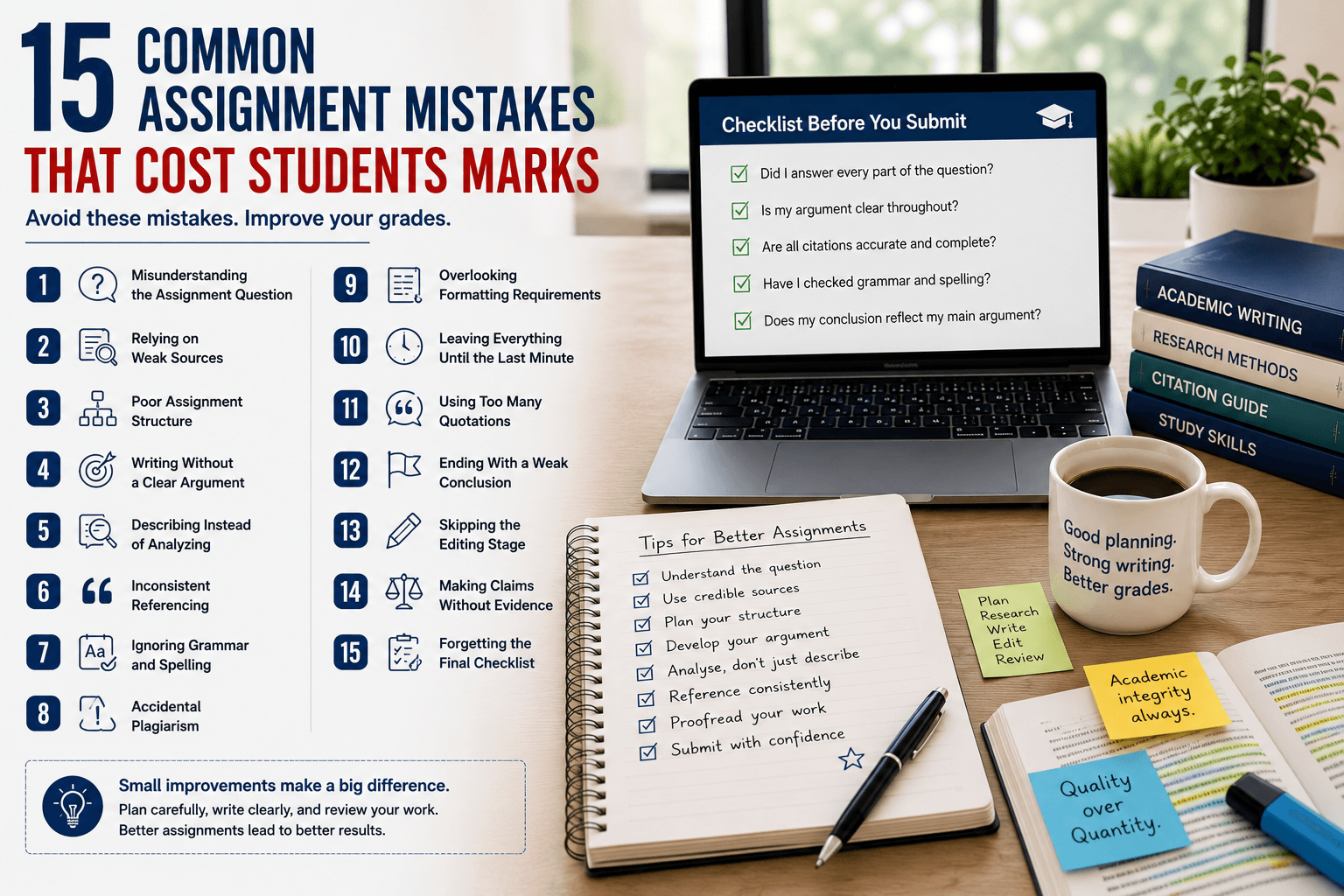
15 Common Assignment Mistakes That Cost Students Marks
Have you ever submitted an assignment feeling confident, only to receive a lower grade than expected? You’re not alone. In many cases, students don’t lose marks because they don’t understand the subject—they lose them because of small writing, formatting, or research mistakes that are easy to overlook.
The good news is that most of these issues are completely avoidable. Once you know what lecturers are looking for, it’s much easier to produce assignments that are clear, well-structured, and academically sound.
Let’s look at some of the most common assignment mistakes and, more importantly, how you can avoid them.
1. Misunderstanding the Assignment Question
One of the biggest mistakes students make happens before they even start writing.
It’s surprisingly common to skim through the assignment brief, assume you know what’s being asked, and begin researching straight away. Unfortunately, this can lead to answering the wrong question.
Take a few minutes to identify the key instruction words such as analyze, compare, evaluate, or critically discuss. These words tell you exactly what your lecturer expects.
2. Relying on Weak Sources
Not every source you find online belongs in an academic paper.
Blogs, random websites, or outdated articles often lack credibility. Instead, try to use peer-reviewed journals, academic books, and trusted publications whenever possible.
High-quality sources make your arguments far more convincing.
3. Poor Assignment Structure
A great idea can easily get lost inside a poorly organized assignment.
Readers should be able to follow your arguments naturally from one section to the next. A simple structure usually works best:
- Introduction
- Main discussion
- Conclusion
- References
Using headings where appropriate can also improve readability.
4. Writing Without a Clear Argument
Many assignments include plenty of information but never make a clear point.
Your thesis statement acts as the foundation of your paper. It tells the reader what you’re arguing and keeps your discussion focused from beginning to end.
If your thesis is vague, your assignment often becomes vague too.
5. Describing Instead of Analyzing
University assignments rarely reward description alone.
Rather than simply explaining what happened, ask yourself questions like:
- Why is this important?
- What evidence supports this?
- Are there alternative viewpoints?
- What are the wider implications?
Critical thinking is often what separates average assignments from excellent ones.
6. Inconsistent Referencing
Incorrect citations are one of the easiest ways to lose marks.
Whether your university uses APA, Harvard, MLA, or OSCOLA, make sure you’re consistent throughout your assignment. Double-check both your in-text citations and your reference list before submitting.
7. Ignoring Grammar and Spelling
Even strong research can lose its impact if the writing contains obvious mistakes.
Simple grammar errors, awkward wording, or spelling mistakes can distract the reader and make your work appear rushed.
Reading your assignment aloud is a surprisingly effective way to spot sentences that don’t sound natural.
8. Accidental Plagiarism
Plagiarism isn’t always intentional.
Sometimes students forget to cite a source, paraphrase too closely, or accidentally reuse wording from their research notes.
Whenever you include someone else’s ideas, make sure they’re properly referenced. It’s always better to spend a few extra minutes checking citations than risk academic penalties later.
9. Overlooking Formatting Requirements
Formatting may seem like a small detail, but lecturers notice it.
Margins, fonts, spacing, headings, page numbers, and title pages all contribute to a professional presentation.
Following your university’s formatting guidelines shows attention to detail.
10. Leaving Everything Until the Last Minute
We’ve all been there.
When you’re rushing to finish before the deadline, it’s much harder to think critically, proofread carefully, or catch mistakes.
Starting even a day or two earlier gives you enough time to step away from your work and review it with fresh eyes.
11. Using Too Many Quotations
Quotations can strengthen an argument, but they shouldn’t dominate your assignment.
Lecturers want to understand your interpretation of the evidence, not simply read pages of quoted material.
Whenever possible, explain ideas in your own words while citing the original source.
12. Ending With a Weak Conclusion
A conclusion shouldn’t simply repeat your introduction.
Instead, briefly summarize your key arguments, reinforce your main point, and leave the reader with a clear understanding of what your assignment has demonstrated.
13. Skipping the Editing Stage
Many students finish writing and immediately submit.
That’s often where avoidable mistakes slip through.
Even a short editing session can improve sentence flow, remove repetition, and make your writing much clearer.
14. Making Claims Without Evidence
Strong academic writing is built on evidence.
Whenever you make a claim, ask yourself whether you’ve supported it with credible research. Unsupported opinions rarely earn high marks.
15. Forgetting the Final Checklist
Before you click “Submit,” take five minutes to review your work.
Ask yourself:
- Did I answer every part of the question?
- Is my argument clear throughout?
- Are all citations accurate?
- Have I checked grammar and spelling?
- Does my conclusion reflect my main argument?
Those final few minutes can often make the biggest difference.
Final Thoughts
Writing a high-quality assignment isn’t about using complicated vocabulary or making your paper longer than everyone else’s. It’s about communicating your ideas clearly, supporting them with credible evidence, and presenting everything in a logical, well-organized way.
Even experienced students benefit from reviewing their work before submission. A fresh set of eyes can often catch unclear sentences, referencing issues, formatting mistakes, or small grammar errors that are easy to miss after hours of writing.
At Writink Studio, we support students through proofreading, editing, constructive feedback, citation assistance, and plagiarism checks to help them polish their own work while respecting their institution’s academic integrity policies.
Remember, better assignments aren’t created overnight—they’re refined through careful planning, thoughtful editing, and attention to detail. Small improvements made consistently can have a noticeable impact on your academic performance over time.