
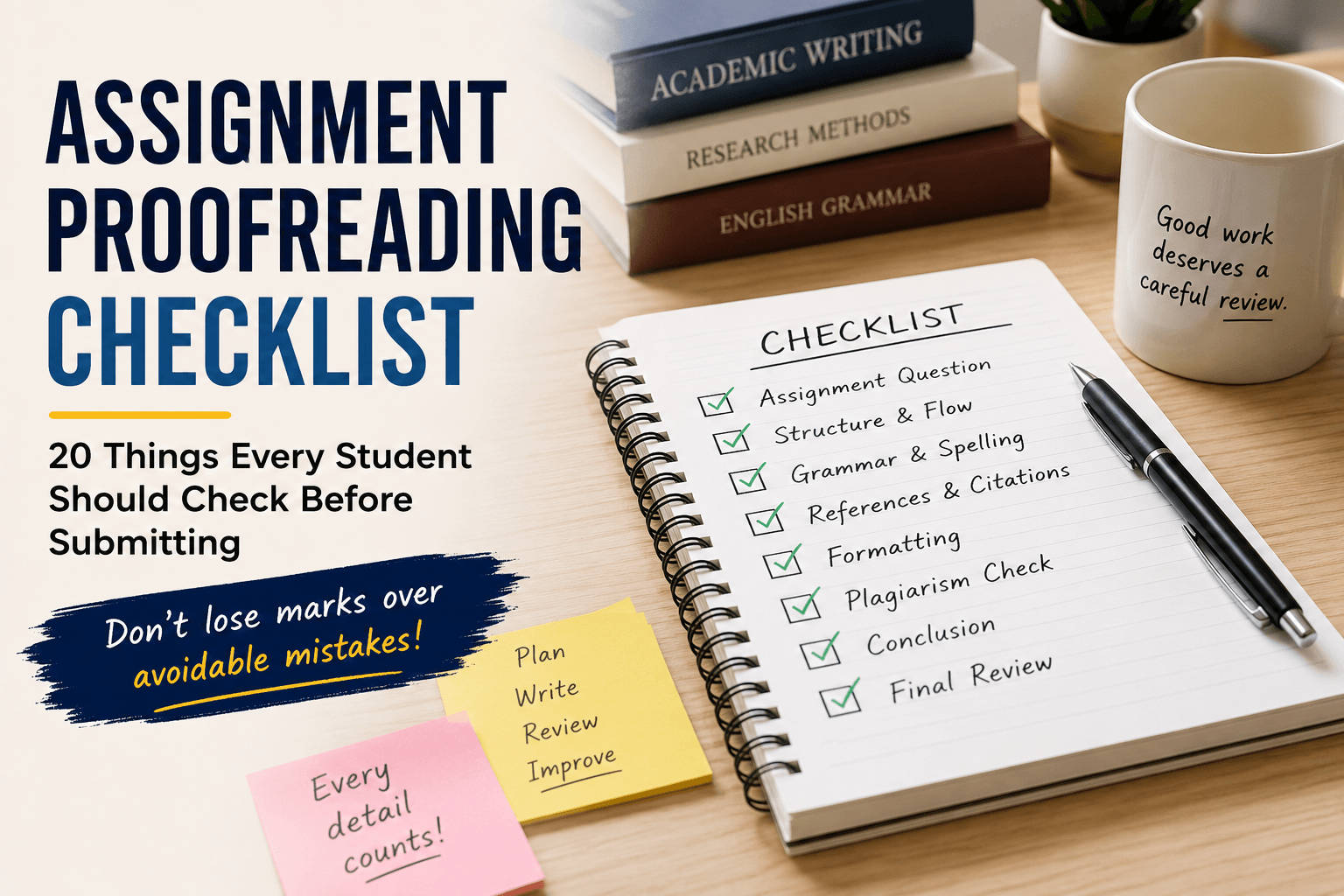
Assignment Proofreading Checklist: 20 Things Every Student Should Check Before Submitting
You’ve finished your assignment. The research is done, the references are in place, and after staring at your screen for hours, you’re tempted to hit the Submit button.
But here’s a question that’s worth asking:
Have you actually checked your assignment, or have you just finished writing it?
There’s a big difference.
I’ve seen students spend days researching a topic only to lose marks because of things that had nothing to do with their knowledge. A citation was missing. A paragraph didn’t flow properly. The conclusion didn’t answer the question. These aren’t major mistakes—but together, they can affect your grade.
That’s why I always recommend doing one final proofreading session before submitting any assignment.
To make things easier, here’s a simple checklist you can follow.
1. Read the Assignment Question Again
It sounds obvious, but it’s surprising how many students drift away from the original question.
Before reviewing anything else, go back to the assignment brief and ask yourself:
- Did I answer every part of the question?
- Have I stayed on topic?
- Did I address exactly what was asked?
2. Check Your Introduction
Your introduction should explain what the assignment is about and what the reader can expect.
If someone only read your introduction, would they understand the purpose of your paper?
3. Make Sure Every Paragraph Has One Main Idea
A common problem is trying to cover too much in a single paragraph.
Each paragraph should focus on one idea before moving naturally to the next.
4. Remove Repeated Points
When you’re writing over several days, it’s easy to repeat yourself without realizing it.
Read through your work and highlight any ideas you’ve already explained.
5. Improve Sentence Flow
Some sentences look fine until you read them aloud.
Reading your assignment out loud is one of the easiest ways to catch awkward wording and overly long sentences.
If you stumble while reading, your lecturer probably will too.
6. Check Grammar and Spelling
Spell check is helpful—but it’s far from perfect.
Words like their, there, and they’re can easily slip through automated tools.
A careful manual review is always worth your time.
7. Verify Every Citation
One missing citation can create unnecessary problems.
Check that every source you’ve used appears in your reference list and follows the required style.
8. Review Your References
Make sure your references are:
- Consistent
- Complete
- Correctly formatted
- Listed alphabetically (if required)
Small referencing mistakes are surprisingly common.
9. Watch Out for Plagiarism
Sometimes plagiarism happens accidentally.
Maybe you copied notes into your draft and forgot to rewrite them.
Maybe your paraphrasing is too close to the original source.
This is the stage where you should double-check everything.
10. Remove Unnecessary Words
Good academic writing is usually clear—not complicated.
If a sentence works without an extra phrase, remove it.
Simple writing is often stronger writing.
11. Check Your Formatting
Look over:
- Font
- Font size
- Line spacing
- Margins
- Page numbers
- Headings
Formatting mistakes are easy to fix but easy to miss.
12. Strengthen Your Conclusion
Your conclusion should leave the reader feeling that your argument has come full circle.
Avoid introducing brand-new ideas here.
Instead, reinforce your main points and tie everything together.
13. Take a Short Break
This might be the most underrated proofreading tip.
Even stepping away for 20–30 minutes can help you notice mistakes that were invisible before.
Fresh eyes make a huge difference.
14. Ask Someone Else to Read It
Another person can often spot confusing sentences that you’ve become blind to.
If that’s not possible, read the assignment slowly from the last paragraph backwards. It forces your brain to focus on individual sentences instead of the overall story.
15. Do One Final Read
Don’t edit while you read.
Just read.
Imagine you’re the lecturer seeing this assignment for the first time.
Does it make sense?
Does every paragraph support your argument?
Would you feel confident grading it?
Final Thoughts
Most students don’t lose marks because they don’t understand the subject.
They lose marks because they submit too quickly.
A final proofreading session usually takes less than half an hour, but it can improve clarity, fix small mistakes, and make your assignment feel much more polished.
If you’ve already done the hard work of researching and writing, it’s worth spending a little extra time making sure your assignment represents your best effort.
At Writink Studio, we help students refine their own work through proofreading, editing, constructive feedback, citation assistance, and plagiarism checks. Our goal isn’t to replace your work—it’s to help you submit a clearer, more polished version of it while respecting your institution’s academic integrity policies.
Quick Assignment Proofreading Checklist
Before you submit, make sure you’ve checked:
- ✅ Assignment question
- ✅ Introduction
- ✅ Paragraph structure
- ✅ Grammar and spelling
- ✅ Sentence flow
- ✅ References
- ✅ Citations
- ✅ Formatting
- ✅ Plagiarism
- ✅ Conclusion
- ✅ Final read-through
A few extra minutes today could save you valuable marks tomorrow.