
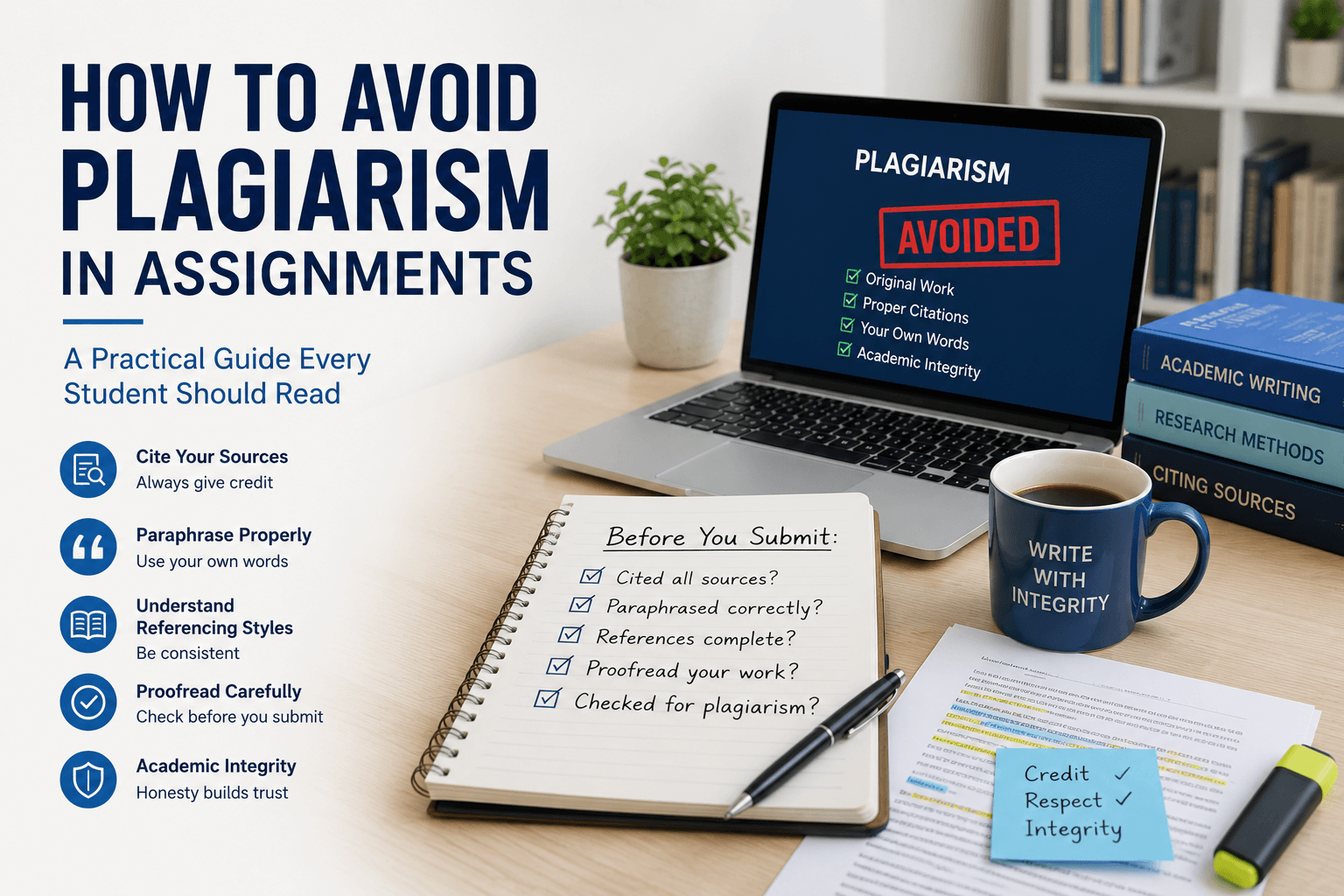
How to Avoid Plagiarism in Assignments: A Practical Guide Every Student Should Read
Most students don’t set out to plagiarize. In fact, many cases happen by accident.
You’re researching late at night, copying useful notes into your document, juggling multiple deadlines, and before you know it, you’ve forgotten which sentences are your own and which came from a source. It’s a stressful situation, and it happens more often than you might think.
The good news is that avoiding plagiarism isn’t as complicated as it sounds. Once you understand a few simple principles, you can write with confidence and submit your work without constantly worrying about academic integrity issues.
In this guide, you’ll learn what plagiarism really is, why it matters, and the practical steps you can take to avoid it in every assignment.
What Is Plagiarism?
Plagiarism is presenting someone else’s words, ideas, or work as your own without giving proper credit. It doesn’t only apply to copying paragraphs from a website. It can also happen when you paraphrase too closely, forget to include a citation, or reuse parts of your own previous work without permission.
Universities take plagiarism seriously because academic writing is built on honesty, originality, and proper acknowledgement of sources.
Why Students Accidentally Plagiarize
When people hear the word “plagiarism,” they often imagine someone deliberately copying an entire essay. In reality, accidental plagiarism is far more common.
Here are a few reasons it happens:
- Taking notes without recording the original source.
- Forgetting to add citations while writing.
- Paraphrasing by changing only a few words.
- Rushing to finish an assignment before the deadline.
- Mixing information from multiple sources without keeping track of where it came from.
If any of these sound familiar, you’re certainly not alone.
7 Practical Ways to Avoid Plagiarism
1. Keep Track of Every Source
One of the smartest habits you can develop is recording your sources as you research.
Instead of thinking, “I’ll add the references later,” create a reference list from the beginning. It only takes a few extra minutes, but it can save you hours of frustration later.
2. Learn How to Paraphrase Properly
Good paraphrasing is much more than replacing a few words with synonyms.
Read the original source carefully, close it, and then explain the idea in your own words as if you were describing it to a classmate. After that, compare your version with the original to make sure the wording is genuinely different.
Even when you paraphrase successfully, you still need to cite the original source.
3. Quote Only When Necessary
Direct quotations can strengthen your assignment, but they shouldn’t dominate it.
Your lecturer wants to understand your interpretation and analysis, not simply read a collection of quotations from other authors.
Whenever possible, explain ideas in your own words while giving proper credit.
4. Understand Your Referencing Style
Whether your university uses APA, Harvard, MLA, or OSCOLA, consistency is essential.
Using the correct referencing style not only helps you avoid plagiarism but also demonstrates professionalism and attention to detail.
If you’re unsure about the required format, check your university’s official guidance before submitting your work.
5. Leave Time for Proofreading
Many plagiarism issues happen because students are rushing.
When you’re trying to finish an assignment an hour before the deadline, it’s much easier to overlook a missing citation or an incomplete reference.
Giving yourself enough time to review your work carefully can make a significant difference.
6. Use Plagiarism Detection Tools Wisely
Plagiarism checkers can help identify passages that need attention, but they shouldn’t replace careful proofreading.
Treat these tools as a final review rather than a guarantee that your assignment is perfect. They’re helpful for spotting potential issues, but you’re still responsible for checking your citations and references.
7. Ask for Feedback Before You Submit
Sometimes you’re simply too close to your own writing to notice problems.
A second pair of eyes can identify unclear paraphrasing, missing citations, awkward wording, or referencing inconsistencies that you may have missed.
Constructive feedback isn’t about changing your ideas—it’s about presenting them more clearly.
Common Myths About Plagiarism
“If I Change a Few Words, It’s No Longer Plagiarism.”
Not necessarily.
If the structure and meaning remain almost identical to the original source, you still need proper citation.
“Everything on the Internet Is Free to Use.”
Information may be publicly available, but that doesn’t remove the need to acknowledge the original author.
“Only Direct Copying Counts as Plagiarism.”
This is another common misunderstanding.
Poor paraphrasing, missing citations, and even reusing your own previous assignments without permission can create academic integrity concerns.
A Quick Checklist Before You Submit
Before clicking the submit button, ask yourself:
- Have I cited every source I’ve used?
- Does every in-text citation appear in my reference list?
- Are my references formatted consistently?
- Have I paraphrased information properly?
- Have I reviewed my assignment for accidental plagiarism?
If you can answer “yes” to each question, you’re already reducing the risk of common mistakes.
Final Thoughts
Avoiding plagiarism isn’t about being afraid of making mistakes. It’s about developing good academic habits that make your writing stronger, more credible, and easier to trust.
The more carefully you research, reference, and review your work, the more confident you’ll feel when submitting it.
If you’d like an extra review before your deadline, Writink Studio offers academic support through proofreading, editing, constructive feedback, citation assistance, and plagiarism checks. Our goal is to help students polish their own work while respecting academic integrity policies, so they can submit with greater confidence.