
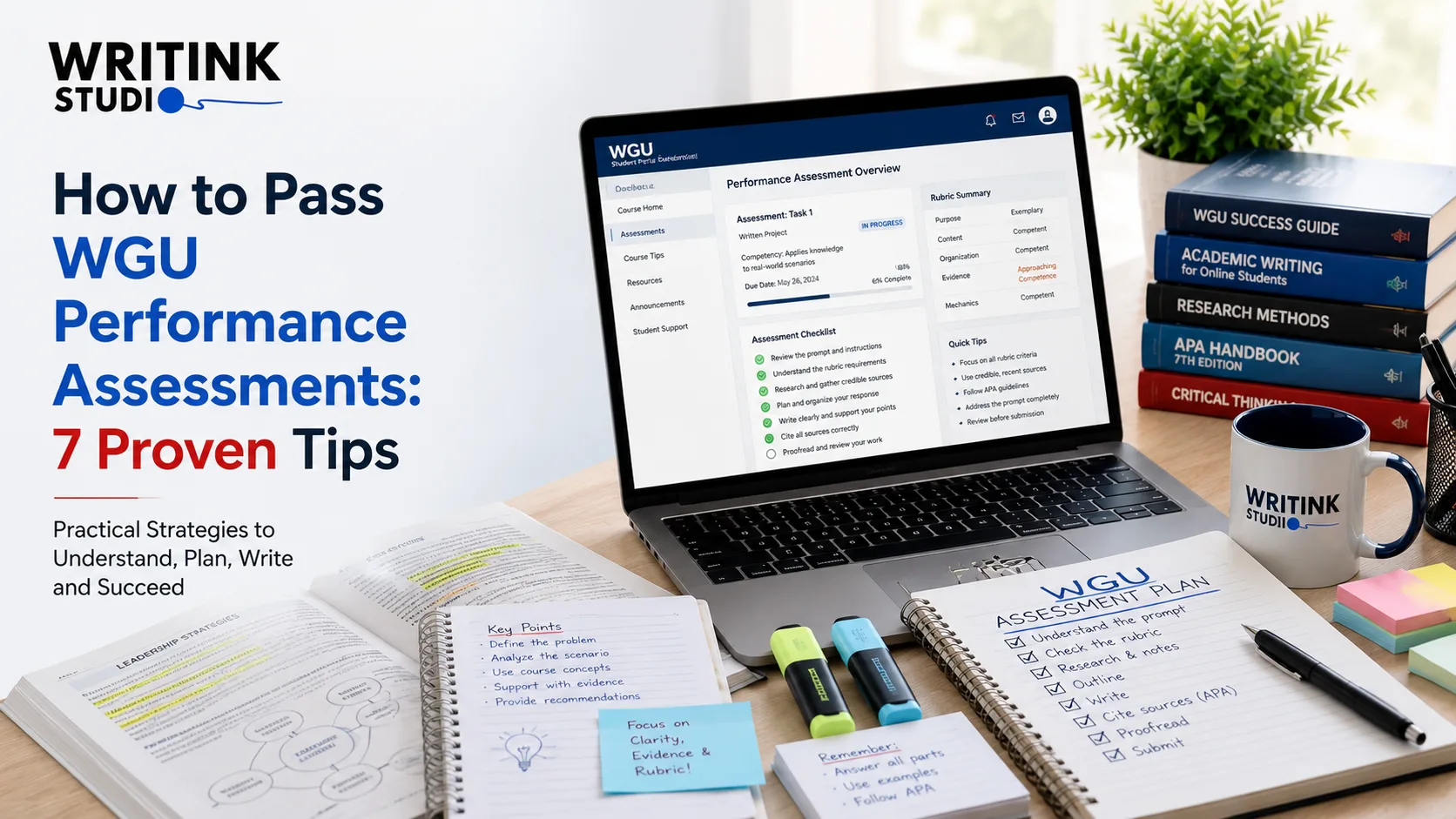
How to Pass WGU Performance Assessments: 7 Proven Tips
If you’re studying at Western Governors University, you’ve probably noticed that WGU performance assessments can feel quite different from traditional college assignments. Instead of simply answering a set of questions, you may be asked to analyze a situation, complete a project, explain your reasoning, or demonstrate that you can apply what you’ve learned.
That’s where WGU performance assessments come in.
For some students, the hardest part isn’t necessarily the subject itself. It’s figuring out exactly what the assessment is asking for, organizing the response, and making sure nothing important has been missed.
The good news? Once you understand how these assessments work, they become much easier to approach.
What Is a WGU Performance Assessment?
A WGU performance assessment gives you an opportunity to demonstrate your knowledge by completing a specific task. Depending on your course, this could involve writing a report, analyzing a case study, creating a project, developing a presentation, or completing another practical activity.
The important thing to remember is that you’re not simply trying to write as much as possible. Your goal is to demonstrate the competencies described in the assessment requirements.
That distinction can make a big difference.
How Do WGU Performance Assessments Work?
Before you start writing, take some time to understand the assessment itself.
Read the instructions from beginning to end. Then go through them again and break the requirements into smaller tasks.
For example, you might make a simple checklist:
- What questions need to be answered?
- What information needs to be researched?
- Which sections require analysis?
- Are sources required?
- Is there a specific format to follow?
- What does the evaluator need to see?
This may sound basic, but it can save you from realizing halfway through your assessment that you’ve overlooked an important requirement.
1. Read the Assessment Instructions Before You Start
One of the easiest mistakes to make with WGU assessments is jumping straight into writing.
You see the first task, start typing, and figure you’ll work out the rest along the way.
That approach can create problems later.
Instead, read the entire assessment first. Pay attention to the words used in each task. If you’re asked to analyze something, simply describing it probably won’t be enough. If you’re asked to evaluate something, you’ll generally need to discuss its strengths, weaknesses, implications, or supporting evidence.
Understanding those differences helps you write an answer that actually addresses the task.
2. Use the WGU Assessment Rubric as Your road map
The WGU assessment rubric is one of the most useful resources you have.
Think of it as a checklist rather than something you only look at after finishing your work.
Go through each criterion and ask yourself what you would need to include to satisfy it.
You could even create a basic table:
Criterion → What the evaluator wants → Where I’ve addressed it
This makes the final review much easier.
Proofreading your WGU assessment is important.
When you’re finished, go through the rubric again and check each requirement individually. Don’t rely on the feeling that you’ve “covered everything.” Verify it.
3. Research Before You Start Writing
Good research doesn’t mean opening ten browser tabs and copying information from each one.
Start by identifying what you actually need to support.
For academic work, useful sources can include peer-reviewed research, university resources, government publications, professional organizations, and reputable academic books.
Once you’ve found a useful source, don’t just add it because it looks impressive. Ask yourself: Does this actually support the point I’m making?
That’s a much better approach to research.
4. Create a Simple Outline
An outline doesn’t have to be complicated.
Even a few bullet points can give your assessment some direction.
For example:
Introduction
Explain the topic and what the assessment will address.
Main sections
Work through each required task individually.
Analysis
Explain your reasoning and support important points with evidence.
Recommendations
Provide recommendations if the assessment requires them.
Conclusion
Bring the main points together.
Your actual structure should always follow the requirements of your particular assessment rather than a generic template.
5. Don’t Confuse Description With Analysis
This is an area where many students struggle.
Imagine you’re asked to analyze a particular business strategy.
Simply explaining what the strategy is would be description.
Explaining why the strategy could work, what its limitations are, what evidence supports it, and what could happen if the organization implemented it is closer to analysis.
Whenever you’re unsure, ask yourself:
“So what?”
Why does this information matter? What does it tell the reader? How does it relate to the situation you’re discussing?
Those questions can push your writing beyond simple description.
6. Use Sources Naturally
Adding citations everywhere doesn’t automatically make an assessment stronger.
The better approach is to use evidence where it actually supports your discussion.
If you’re making a factual claim, look for an appropriate source. If you’re recommending a particular approach, explain your reasoning and use evidence where necessary.
Also remember to check your references before submitting. A citation in your text should correspond with the correct source in your reference list.
7. Follow the Formatting Requirements
Formatting is easy to overlook when you’re concentrating on the actual content.
Before submitting your WGU assignment, check the assessment requirements again.
Look for instructions relating to:
- File format
- Headings
- Citations
- References
- Tables or figures
- Page organization
- Other submission requirements
Don’t assume that every WGU assessment has identical requirements. Always follow the instructions for the specific assessment you’re completing.
8. Leave Time to Proofread
If you’ve spent several hours working on an assessment, you’re probably not the best person to immediately spot every mistake in it.
Your brain knows what you intended to write, so it can easily overlook a missing word or awkward sentence.
If possible, step away from the document for a while and come back to it later.
Look for:
- Grammar and spelling mistakes
- Repeated ideas
- Unclear sentences
- Missing information
- Citation problems
- Formatting inconsistencies
Professional proofreading services
A fresh review can make a surprisingly noticeable difference.
Common WGU Performance Assessment Mistakes
A few mistakes appear again and again when students work on WGU online classes and assessments.
Not answering every requirement
You might write an excellent response but still miss part of the task. Go through every requirement before submitting.
Ignoring the rubric
Don’t treat the rubric as an afterthought. Use it while you’re writing.
Including unnecessary information
More words don’t necessarily mean a better assessment. Stay focused on the actual question.
Using unreliable sources
A random website isn’t necessarily suitable evidence for academic work. Consider the credibility and relevance of every source you use.
Leaving proofreading until the last minute
Small errors are much easier to fix when you aren’t rushing toward a submission deadline.
WGU Performance Assessment vs. Objective Assessment
WGU students may encounter both performance assessments and objective assessments.
A performance assessment generally requires you to demonstrate competency through a written response, project, presentation, or another practical task.
An objective assessment typically tests your knowledge through questions.
The preparation strategy can therefore be different. With a performance assessment, understanding the requirements and planning your response are particularly important.
How to Prepare for a WGU Performance Assessment
The best time to prepare for an assessment isn’t the night before it’s due.
Start by understanding the task. Break it into manageable sections, gather your research, create an outline, and work through each requirement one at a time.
Most importantly, give yourself enough time for a final review.
If you’ve completed your own draft but aren’t confident about its clarity, grammar, organization, or referencing, getting constructive feedback can be useful.
Final WGU Assessment Checklist
Before submitting your WGU performance assessment, take a few minutes to ask:
- Have I answered every part of the task?
- Have I addressed every rubric criterion?
- Is my response clear and logically organized?
- Have I supported important claims with appropriate evidence?
- Are my citations and references consistent?
- Have I followed the required formatting?
- Have I checked for grammar and spelling errors?
- Does the final submission demonstrate my own understanding?
If you can confidently answer yes to these questions, you’re in a much better position to submit.
Final Thoughts
Learning how to pass WGU performance assessments isn’t about writing hundreds of unnecessary words or trying to make your work sound overly complicated.
It’s about understanding what you’re being asked to demonstrate and then presenting that understanding clearly.
Read the instructions. Use the rubric. Research carefully. Organize your response. Give yourself enough time to review everything before submitting.
And if you’ve already written your assessment but want help improving the grammar, clarity, structure, citations, or overall presentation, Writink Studio provides proofreading, editing, citation assistance, and constructive academic feedback designed to help students strengthen their own work.