
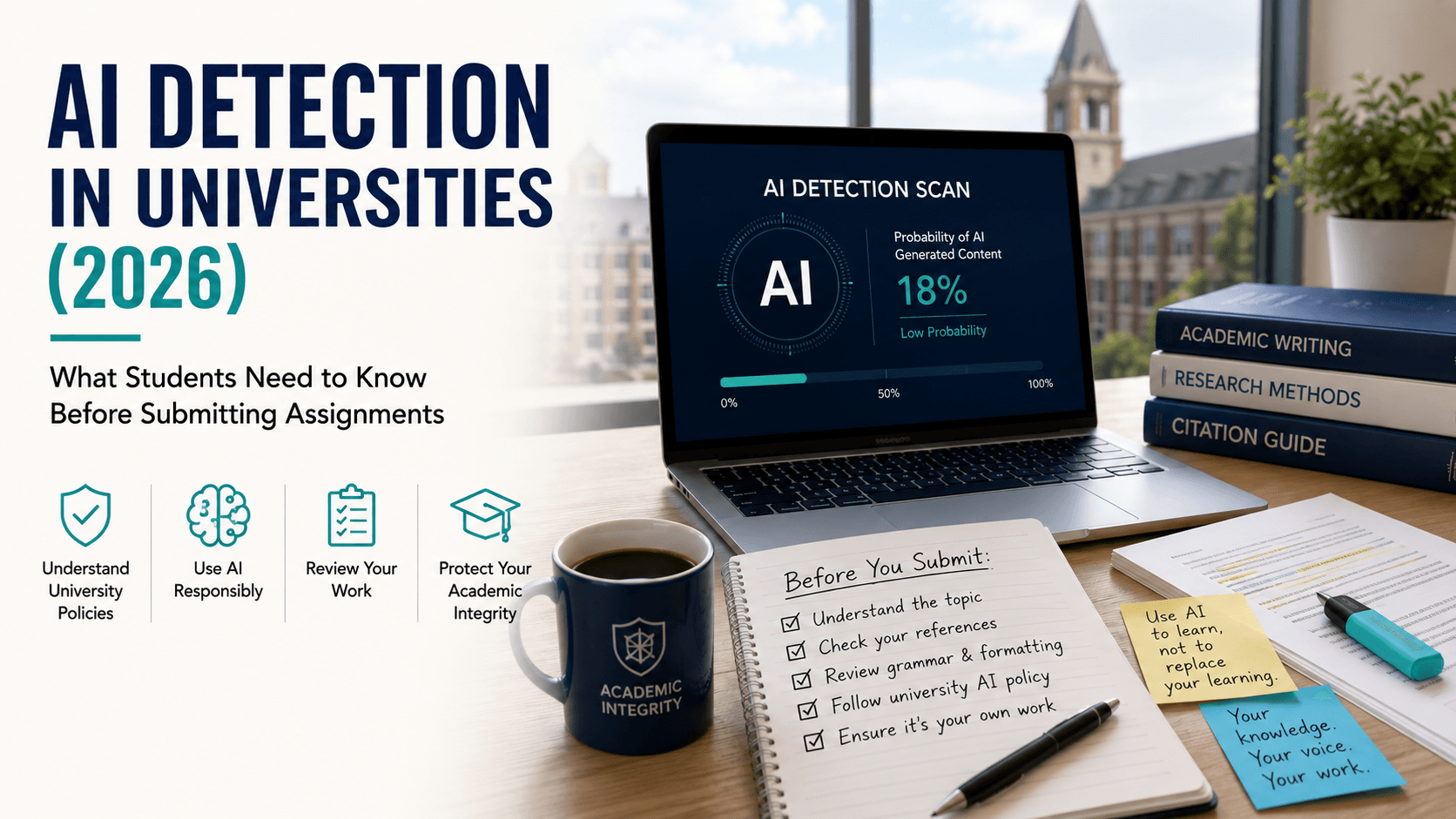
AI Detection in Universities (2026): What Students Need to Know Before Submitting Assignments
If you’ve spent any time on student forums recently, you’ve probably noticed the same question coming up again and again regarding AI Detection in Universities:
“Can my university detect AI-written assignments?”
It’s a fair question.
Artificial intelligence has become part of everyday student life. Some students use it to brainstorm ideas, others use it to understand difficult topics, and some rely on it far more than they probably should. AI Detection in Universities is important yet relatively less-explored topic.
At the same time, universities are updating their academic integrity policies and encouraging students to use AI responsibly rather than assuming every assignment was written without assistance.
The challenge isn’t simply whether AI can be detected—it’s whether your work genuinely reflects your own understanding.
In this guide, we’ll look at how universities approach AI in 2026, common misconceptions, and practical ways to use AI responsibly while protecting your academic integrity.
Do Universities Have AI Detectors?
Many institutions use tools that attempt to identify writing patterns associated with AI-generated text.
However, these tools are not perfect.
Even universities and technology providers acknowledge that AI detection systems can produce false positives and false negatives.
That’s why many lecturers don’t rely on detection software alone.
Instead, they evaluate:
- Your writing style
- Your understanding of the topic
- Your ability to explain your ideas
- Your research quality
- Your references and evidence
- Previous assignments you’ve submitted
In other words, they’re assessing your learning—not just your wording.
The Biggest Mistake Students Make
One of the most common mistakes isn’t using AI.
It’s copying AI-generated text directly into an assignment without reviewing or understanding it.
That creates several problems.
The writing may sound generic.
Important details might be inaccurate.
References can be incomplete or even fabricated.
Most importantly, the final submission no longer reflects your own knowledge.
AI should support your thinking—not replace it.
Responsible Ways to Use AI
Used carefully, AI can become a valuable study partner.
Students commonly use it to:
- Brainstorm assignment ideas
- Create study plans
- Simplify difficult concepts
- Improve grammar and clarity
- Generate practice questions
- Review paragraph structure
These uses help you learn without replacing your own work.
Don’t Forget Your University’s Policy
Every university has its own expectations regarding AI.
Some allow certain forms of assistance.
Others require students to declare how AI was used.
Before submitting any assignment, take a few minutes to read your institution’s academic integrity guidance.
It can save you unnecessary stress later.
Five Questions to Ask Yourself Before Submitting
Before clicking Submit, ask yourself:
- Could I explain every paragraph in my own words?
- Have I checked every reference?
- Does the assignment reflect my own understanding?
- Have I reviewed grammar and formatting?
- Am I following my university’s AI policy?
If the answer to any of these questions is “no,” spend a little more time improving your work.
Final Thoughts
Artificial intelligence isn’t disappearing from education anytime soon.
The students who benefit most won’t be those who depend on AI for every sentence—they’ll be the ones who use it thoughtfully while continuing to develop their own research, analysis, and writing skills.
Before submitting any assignment, take time to review your work carefully. Proofreading, accurate citations, and thoughtful editing remain just as important as ever.
At Writink Studio, we support students through proofreading, editing, constructive feedback, citation assistance, and plagiarism checks. Our goal is to help you refine your own work while respecting your university’s academic integrity policies and producing assignments you can submit with confidence.
Frequently Asked Questions
Can universities accurately detect AI-written assignments?
Detection tools exist, but no tool is perfectly accurate. Universities typically combine software with academic judgment and knowledge of a student’s writing style.
Is it acceptable to use AI for proofreading?
Many institutions distinguish between proofreading and generating original content, but you should always follow your university’s specific AI policy.
Can AI create references?
AI can suggest references, but students should always verify them using reliable academic sources before submission.
What’s the safest way to use AI?
Use it to support learning—brainstorm ideas, improve clarity, organize information, and review your writing—while ensuring the final work reflects your own understanding.