
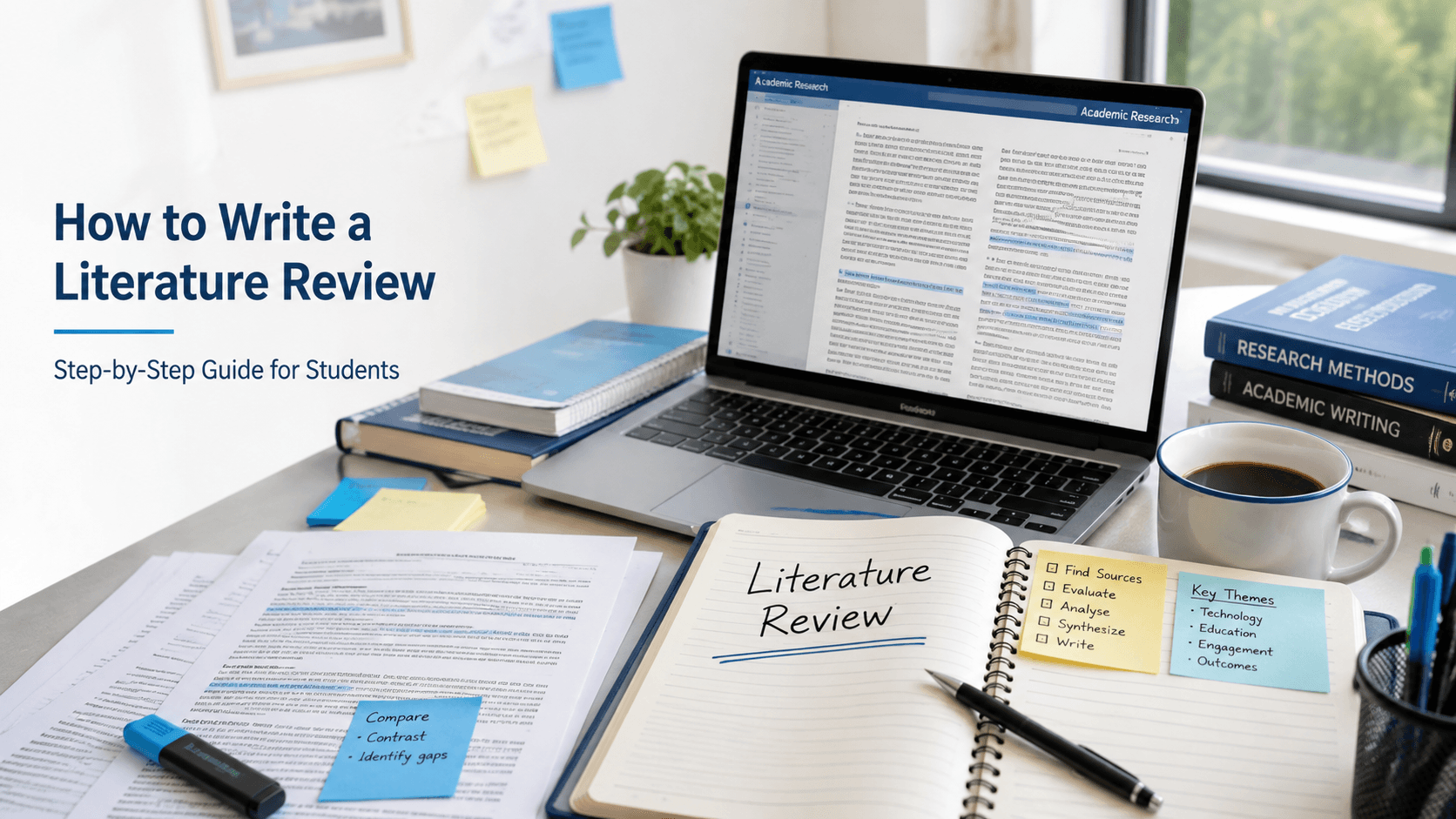
How to Write a Literature Review: A Step-by-Step Guide for University Students
If you’re wondering how to write a literature review, you’re definitely not alone. It’s one of the most challenging parts of an assignment for many students—not because it’s difficult to understand, but because it requires a different way of thinking.
The first time I wrote a literature review, I made the same mistake that thousands of students make every year. I thought my job was to summarize every article I had read. By the time I finished, my lecturer’s feedback was simple but memorable: “This is a collection of summaries, not a literature review.”
That advice completely changed the way I approached academic writing.
A good literature review isn’t about proving how many sources you’ve read. It’s about showing that you understand the existing research, can identify patterns, compare different viewpoints, and explain where your own work fits into the conversation.
In this guide, you’ll learn how to write a literature review step by step, avoid common mistakes, and produce a review that demonstrates critical thinking rather than simple description.
What Is a Literature Review?
A literature review is a critical evaluation of published research on a specific topic.
Instead of discussing one source after another, you compare different studies, identify trends, point out disagreements, and explain how previous research relates to your own assignment or project.
Think of it as joining an ongoing conversation between researchers. Your role isn’t to repeat what everyone has already said—it’s to show that you understand the conversation and can contribute to it.
Why Is a Literature Review Important?
Many students treat the literature review as just another section of an assignment.
In reality, it’s often one of the first things lecturers read to judge how well you’ve understood your topic.
A strong literature review shows that you can:
- Research reliable academic sources.
- Evaluate different opinions objectively.
- Build evidence-based arguments.
- Identify gaps in existing research.
- Support your own ideas with credible evidence.
These are valuable academic skills that apply far beyond a single assignment.
How to Write a Literature Review Step by Step
The easiest way to write a literature review is to break the process into manageable steps.
Step 1: Understand Your Research Question
Before opening Google Scholar or your university library, spend a few minutes understanding exactly what your assignment is asking.
A clear research question acts like a map. It helps you decide which sources are relevant and prevents you from collecting dozens of articles that don’t actually answer your question.
Whenever you’re unsure whether a source belongs in your review, ask yourself:
“Does this help me answer my research question?”
If the answer is no, it’s probably not worth including.
Step 2: Find Reliable Sources
The quality of your literature review depends on the quality of your research.
Prioritize sources such as:
- Peer-reviewed journal articles
- Academic books
- Government publications
- University research
- Reputable professional organizations
Avoid relying heavily on blogs, forums, or websites without credible authors.
A few high-quality sources are far more valuable than dozens of unreliable ones.
Step 3: Read Like a Researcher
Don’t simply highlight every paragraph and move on.
Instead, make notes about:
- The author’s main argument.
- Research methods used.
- Key findings.
- Strengths of the study.
- Limitations.
- How it compares with other research.
This habit saves an incredible amount of time when you start writing because you’ve already organized your thoughts.
Step 4: Organize Your Sources
One of the biggest mistakes students make is writing about sources one by one.
Imagine reading twenty separate summaries.
It would quickly become repetitive.
Instead, group studies together based on common themes, viewpoints, research methods, or time periods.
For example, if several researchers reached similar conclusions, discuss them together before introducing studies that present a different perspective.
This approach creates a smoother and more professional flow.
Step 5: Focus on Analysis, Not Summary
This is where many students lose marks.
A literature review isn’t simply about explaining what each researcher said.
Your job is to compare, evaluate, and interpret.
Instead of writing:
“Johnson (2024) found that online learning improves student engagement.”
Go a step further.
“While Johnson (2024) argues that online learning improves engagement, later studies by Smith (2025) suggest that the outcome depends largely on course design and student participation. Together, these findings indicate that technology alone is not enough to improve learning outcomes.”
Notice the difference?
You’re connecting ideas instead of listing them.
That’s what lecturers want to see.
Common Literature Review Mistakes
Even strong students make avoidable mistakes.
Here are the ones I see most often.
Summarizing Everything
If every paragraph starts with an author’s name followed by what they said, you’re probably writing summaries instead of analysis.
Your voice should guide the discussion.
The sources should support your argument—not replace it.
Using Outdated Research
In fast-moving subjects, older studies may no longer reflect current knowledge.
Whenever possible, include recent research alongside foundational studies.
Ignoring Conflicting Evidence
Not every researcher agrees.
A balanced literature review acknowledges different viewpoints and explains why those differences exist.
This demonstrates critical thinking and strengthens your credibility.
Weak Organization
Jumping randomly between ideas makes your review difficult to follow.
Use clear themes and logical transitions so readers always know why you’re discussing a particular study.
A Simple Checklist Before You Submit
Before submitting your assignment, take five minutes to review your literature review.
Ask yourself:
- Have I answered my research question?
- Did I compare different studies instead of simply summarizing them?
- Have I included recent and reliable sources?
- Are my citations accurate and consistent?
- Does every paragraph contribute to my overall argument?
If you can confidently answer “yes” to these questions, you’re already ahead of many students.
Final Thoughts
Learning how to write a literature review takes practice, and that’s perfectly normal. Even experienced researchers revise their reviews several times before they’re satisfied.
Don’t aim for perfection in your first draft. Focus on understanding the research, organizing your ideas clearly, and explaining the relationships between different studies.
The more literature reviews you write, the more natural the process becomes.
And remember, a great literature review isn’t the one with the most sources—it’s the one that helps readers understand the research in a clear, logical, and meaningful way.
Before you submit your assignment, take time to proofread your work, check your citations, and make sure your arguments flow naturally. Small improvements at the editing stage can make a noticeable difference to the overall quality of your writing.