
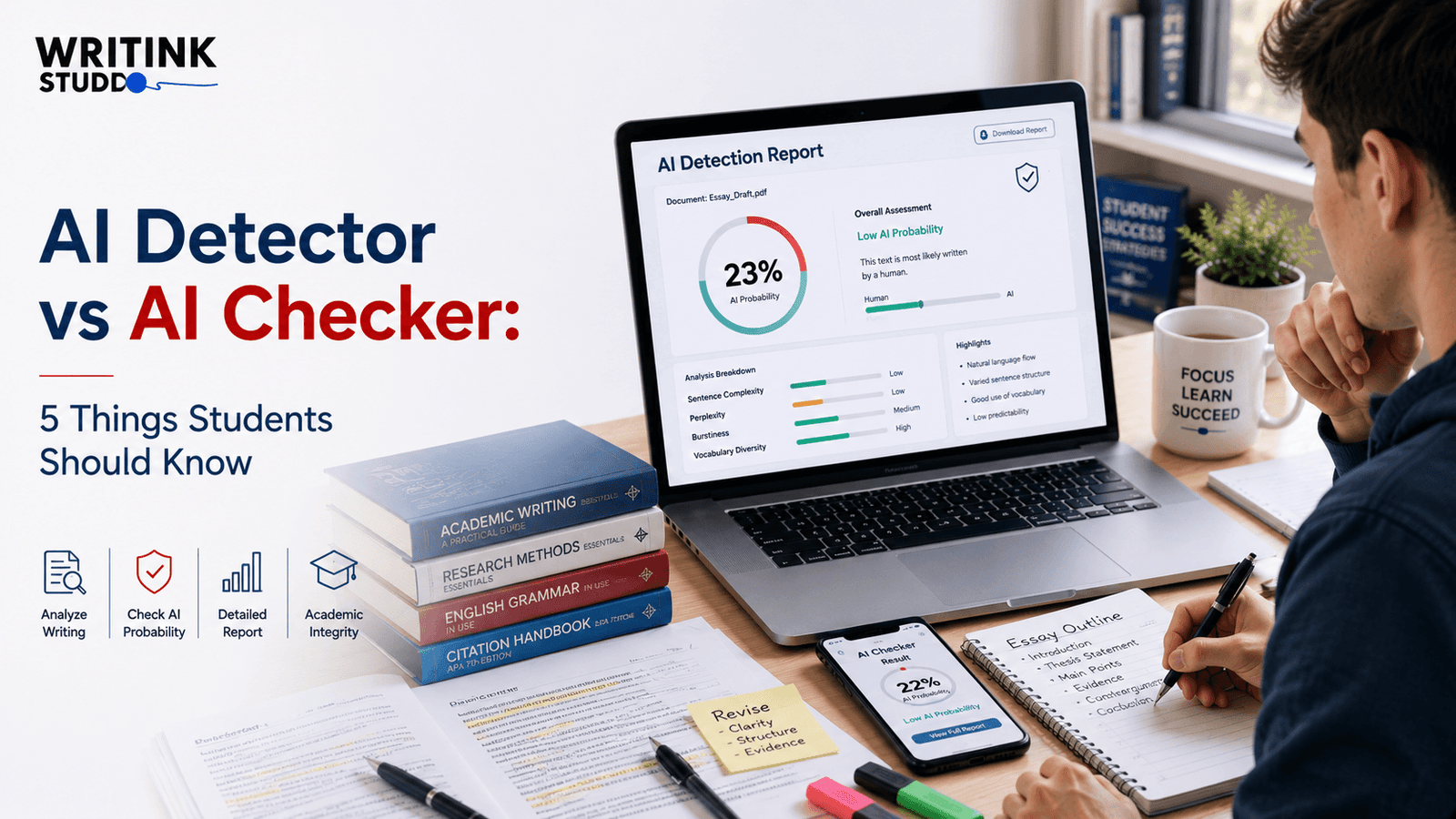
AI Detector vs AI Checker: 5 Things Students Should Know
AI writing tools have become a normal part of student life. They can help with brainstorming, explaining difficult topics, or improving a rough draft. But they also raise an important question: Will an AI detector or AI checker flag my work?
The answer isn’t always straightforward. AI detection tools can be useful, but they are not perfect. If you’re submitting an essay, research paper, thesis, or other academic work, it’s better to understand how these tools work and what they actually mean for students.
What Is an AI Detector?
An AI detector is software designed to estimate whether a piece of writing was produced by artificial intelligence.
Instead of simply searching for copied sentences, these tools usually examine patterns in the writing. They may look at things such as:
- Sentence structure
- Word choices
- Predictability of language
- Writing patterns
- Variation between sentences
- Overall style and consistency
The tool then produces a score or percentage indicating how likely the content appears to be AI-generated.
However, an AI detection score isn’t proof that a student used AI. Human writing can sometimes be flagged as AI-generated, particularly when the writing is very formal, repetitive, or highly polished.
AI Detector vs. AI Checker: Is There a Difference?
The terms AI detector and AI checker are often used interchangeably.
In practice, both can refer to tools that analyze text for signs of AI-generated writing. The exact features depend on the platform.
Some AI checkers may also offer additional features, such as grammar checking, plagiarism checking, or suggestions for improving readability.
So, if you’re a student, don’t focus too much on the name of the tool. What matters is how your university or instructor uses the results.
Can AI Detectors Be Wrong?
Yes.
This is one of the most important things students should understand.
AI detectors don’t have access to a hidden record showing who actually wrote a document. They make a prediction based on characteristics of the text.
That means a genuine piece of student writing can potentially receive a high AI score.
For this reason, you shouldn’t assume that a particular percentage automatically means your assignment has violated an academic policy.
If you’re concerned about an AI detection result, look at your university’s academic-integrity policy and keep evidence of your writing process, such as drafts, research notes, outlines, and references.
How Students Can Use AI Responsibly
Using AI for schoolwork isn’t necessarily the same thing as cheating. The rules depend on your institution, instructor, course, and the specific assignment.
For example, an instructor might allow AI for:
- Brainstorming ideas
- Understanding difficult concepts
- Creating an initial outline
- Checking grammar
- Finding areas that need clarification
Another instructor may prohibit AI-generated content completely.
That’s why checking your course or university’s AI policy should come before using an AI tool for an assignment.
How to Make Your Academic Writing More Authentic
Rather than trying to “beat” an AI detector, focus on producing work that genuinely represents your own thinking.
Start with your own ideas and research. Explain concepts in your own words, use sources appropriately, and make sure your arguments reflect your understanding of the subject.
You should also proofread your work carefully. Awkward sentences, unnecessary repetition, unsupported claims, and inconsistent formatting can weaken an otherwise good assignment.
If you need help improving an existing draft, professional proofreading and editing support can help identify grammar, clarity, structure, and formatting problems without replacing your own ideas.
What Should You Do If Your Work Is Flagged?
Don’t panic.
First, check what your instructor or university actually considers evidence of inappropriate AI use. Then review the highlighted sections and compare them with your drafts and notes.
If you wrote the work yourself, having your research, outlines, earlier drafts, and revision history can help demonstrate how the assignment was developed.
Most importantly, don’t rewrite your work simply to chase a particular AI-detector score. A detector’s percentage should not become the goal of your writing.
Final Thoughts
AI detectors and AI checkers can provide useful signals, but they aren’t perfect judges of authorship. For students, the safest approach is simple: understand your institution’s rules, use AI only where it is permitted, and make sure your submitted work genuinely reflects your own learning and ideas.
If you’re unsure about a paper before submitting it, proofreading and editing can also help you catch problems with clarity, grammar, structure, and presentation.
You can check our Proofreading Services
You can also check this article (Artificial Intelligence and the future of teaching) by US Department of Education