
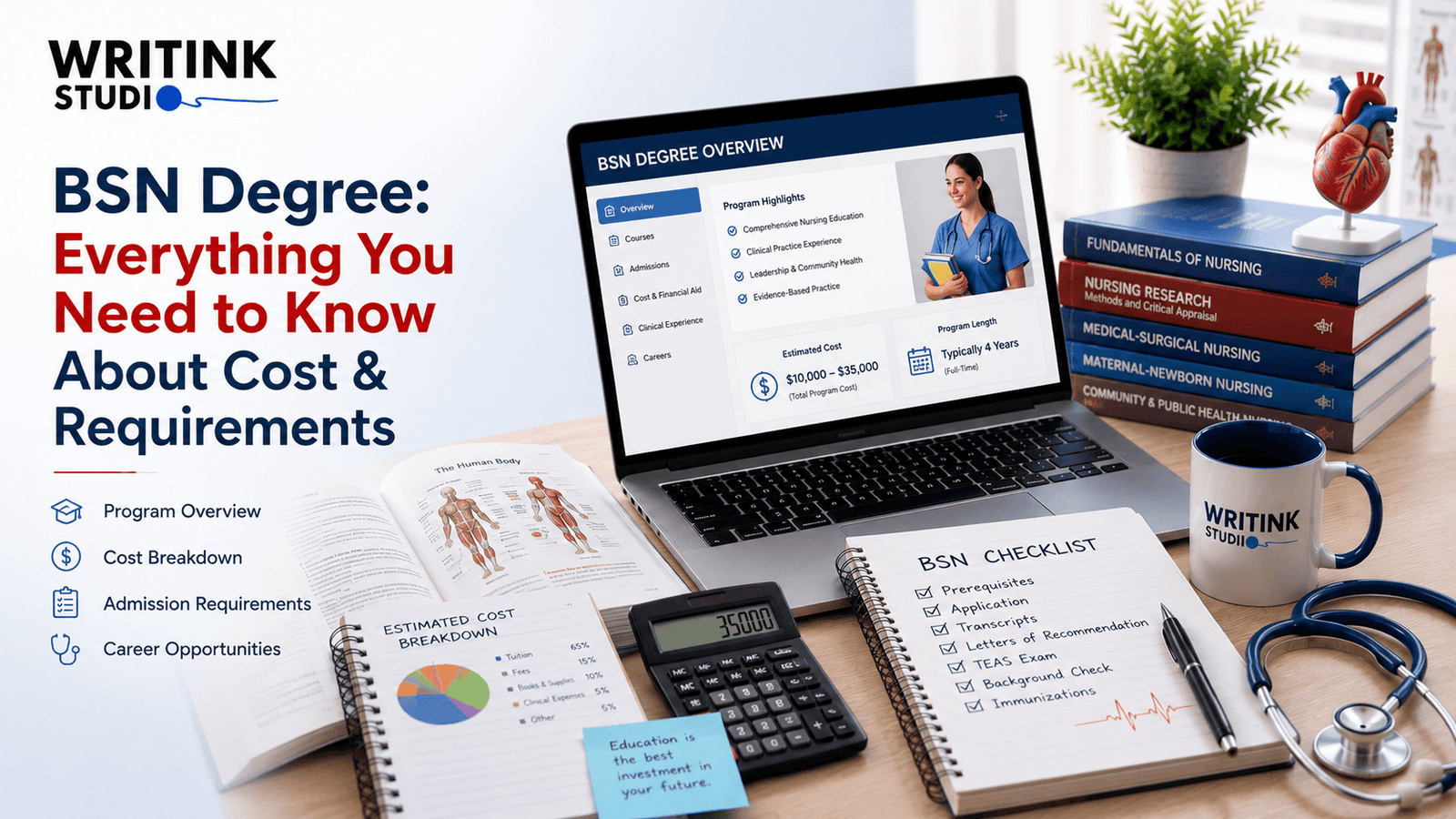
BSN Degree: Everything You Need to Know About Cost & Requirements
If you’re considering a career in nursing, you’ve probably come across the term BSN degree. But what exactly does it mean, how long does it take to earn one, and is a Bachelor of Science in Nursing worth the investment?
A BSN, or Bachelor of Science in Nursing, is a bachelor’s-level nursing degree that prepares students for professional nursing practice. In the United States, a traditional BSN program generally takes about four years to complete and combines classroom education with hands-on clinical experience.
For many students, a BSN can also provide a stronger foundation for future career advancement, leadership positions, graduate nursing education, and specialized areas of healthcare.
Here’s what you need to know about a BSN degree, including requirements, coursework, cost, licensing, and career options.
What Is a BSN Degree?
A Bachelor of Science in Nursing (BSN) is an undergraduate degree designed to prepare students for professional nursing practice.
Unlike nursing programs that focus primarily on the technical aspects of patient care, BSN programs typically include broader education in areas such as leadership, communication, research, public health, critical thinking, and evidence-based practice.
The American Association of Colleges of Nursing (AACN) describes baccalaureate nursing education as preparation for professional nursing practice and emphasizes skills such as critical thinking, leadership, health promotion, and broader clinical preparation.
A BSN is not, by itself, the nursing license. After completing an approved prelicensure nursing program, graduates generally need to meet their state’s licensing requirements and pass the required licensing examination to become registered nurses (RNs).
How Long Does a BSN Take?
A traditional BSN program typically takes four years of full-time study.
The exact length can vary depending on the university, course load, prerequisites, clinical requirements, and whether a student studies full-time or part-time.
Students who already hold an associate degree in nursing or are already licensed RNs may have another option: an RN-to-BSN program.
These programs allow registered nurses to build on their previous nursing education and complete bachelor’s-level coursework. According to AACN’s 2026 data, RN-to-BSN programs generally take about one to two years, although the actual timeframe depends on the student’s previous education and the university’s requirements.
There are also accelerated BSN programs for people who already have a bachelor’s degree in another field. These programs can provide a faster route into nursing, although they are often intensive.
What Are the Requirements for a BSN Program?
BSN admission requirements vary from one university to another. However, students applying to traditional BSN programs commonly need to meet several academic and application requirements.
These may include:
- A high school diploma or equivalent
- Completion of prerequisite courses
- Minimum GPA requirements
- Biology or other science coursework
- Anatomy and physiology
- Microbiology
- Mathematics
- English or communication courses
- An application to the nursing program
- Letters of recommendation or personal statements at some schools
- Entrance examinations at some institutions
- Background checks or health documentation before clinical placement
Some nursing programs are highly competitive, so meeting the minimum requirements does not necessarily guarantee admission.
It’s important to check the specific requirements of each nursing school before applying.
What Do You Study in a BSN Program?
A BSN curriculum usually combines general education, nursing theory, science courses, and supervised clinical experience.
Common subjects can include:
Anatomy and Physiology
Students learn how the human body is structured and how its systems function.
Microbiology
This course introduces microorganisms and their relationship to human health and disease.
Pharmacology
Students learn about medications, their effects, safe administration, and potential risks.
Health Assessment
Nursing students develop skills for assessing patients and identifying changes in their health.
Medical-Surgical Nursing
This area focuses on caring for patients with a wide range of medical and surgical conditions.
Pediatric Nursing
Students learn about healthcare needs and nursing care for children and adolescents.
Maternal and Newborn Nursing
This coursework focuses on pregnancy, childbirth, postpartum care, and newborn health.
Mental Health Nursing
Students learn how nurses support patients experiencing mental and behavioral health conditions.
Community and Public Health
BSN education can include broader preparation in community health, disease prevention, health promotion, and population-focused care.
Leadership and Nursing Research
Bachelor’s-level education also emphasizes leadership, communication, evidence-based practice, research, and critical thinking.
Clinical education is another major part of BSN preparation. Students apply what they learn in the classroom in supervised healthcare environments.
How Much Does a BSN Degree Cost?
The cost of a BSN degree can vary dramatically depending on the school and the student’s circumstances.
Factors that can affect the total cost include:
- Public vs. private university
- In-state vs. out-of-state tuition
- Online vs. campus-based education
- Program length
- Transfer credits
- Housing and living expenses
- Books and course materials
- Clinical equipment
- Uniforms
- Transportation
- Licensing and examination expenses
Because of these differences, there is no single price that applies to every BSN program.
Students should look beyond the advertised tuition price and calculate the total estimated cost of attendance.
It’s also worth investigating financial aid, scholarships, grants, employer tuition assistance, and other funding options before deciding where to study.
Do You Need a BSN to Become an RN?
Not necessarily.
In the United States, registered nurses can enter the profession through several educational pathways, including a bachelor’s degree in nursing, an associate degree in nursing, or an approved diploma program. All routes still involve meeting state licensing requirements.
However, earning a BSN can provide additional educational preparation and may expand career opportunities.
The AACN reports that many healthcare employers either require or prefer baccalaureate-level nursing preparation for certain positions. In its 2023 employment research, 25% of responding healthcare employers required a BSN for new RN hires, while 69.8% expressed a strong preference for BSN graduates.
Requirements vary by employer, location, specialty, and position, so students should research the types of nursing jobs they eventually want.
What Happens After You Earn a BSN?
For students completing a prelicensure BSN program, graduation is not necessarily the final step.
In general, the process involves:
1. Complete an approved nursing program
Students must complete the required nursing education.
2. Apply for RN licensure
Licensing requirements are established by the relevant state nursing regulatory authority.
3. Take the required licensing examination
Graduates who meet eligibility requirements can take the NCLEX-RN.
4. Obtain nursing licensure
Once licensing requirements are satisfied, the graduate can practice as an RN under the rules of the state where they are licensed.
Licensing requirements can differ by state, so prospective nursing students should always check their state’s board of nursing for current requirements.
What Careers Can You Pursue With a BSN?
A BSN can open the door to many nursing career paths.
Staff Registered Nurse
Many BSN graduates begin their careers as registered nurses in hospitals, clinics, healthcare systems, or other patient-care environments.
Critical Care Nurse
Critical care nurses care for seriously ill or unstable patients, often in intensive care environments.
Emergency Department Nurse
Emergency nurses care for patients who require immediate assessment and treatment.
Pediatric Nurse
Pediatric nurses work with infants, children, and adolescents.
Public Health Nurse
Public health nurses focus on community health, prevention, education, and population health.
School Nurse
Some registered nurses work in educational settings and provide healthcare services to students.
Oncology Nurse
Oncology nurses care for patients receiving treatment for cancer and support patients and families throughout their healthcare journey.
Mental Health Nurse
These nurses provide care and support to patients experiencing mental and behavioral health conditions.
Nurse Manager or Leadership Roles
A BSN can also provide a foundation for nurses who want to move into leadership and management as they gain experience.
Graduate Nursing Education
For nurses interested in advanced practice, education, administration, research, or other specialized roles, a BSN can serve as a foundation for graduate-level nursing education.
AACN notes that graduate nursing education can lead to roles including nurse practitioner, nurse midwife, clinical nurse specialist, nurse anesthetist, nurse administrator, researcher, and educator.
Is a BSN Worth It?
For many students, a BSN can be a worthwhile investment, particularly if they want broader career flexibility or plan to pursue advanced nursing education later.
The U.S. Bureau of Labor Statistics reports that registered nurses had a median annual wage of $93,600 in May 2024, with employment projected to grow 5% from 2024 to 2034. The BLS also projects approximately 166,100 additional RN jobs over that period and about 189,100 openings per year on average, including openings resulting from workers leaving or transferring out of the occupation.
However, salary and employment opportunities vary significantly by location, specialty, experience, employer, and education.
A BSN may be particularly attractive if you want to:
- Work in a wide range of healthcare settings
- Compete for positions where employers prefer BSN preparation
- Develop leadership and critical-thinking skills
- Pursue nursing specialties
- Continue into graduate nursing education
- Keep more career options open as your experience grows
BSN vs. ADN: What’s the Difference?
One of the most common questions prospective nursing students ask is whether they should pursue a BSN or an Associate Degree in Nursing (ADN).
An ADN generally provides a shorter pathway into registered nursing, while a BSN provides bachelor’s-level education and broader coursework.
The choice depends on factors such as:
- Your budget
- How quickly you want to enter the workforce
- Your long-term career goals
- Local employer requirements
- Your plans for graduate school
- Whether you already have nursing education
Another possibility is to begin with an ADN and later complete an RN-to-BSN program.
This pathway allows nurses to gain their RN qualification first and then continue their education. AACN reports that hundreds of articulation agreements exist between ADN programs and four-year institutions to help students transition into bachelor’s-level nursing education.
What Should You Look for in a BSN Program?
Choosing a nursing school requires more than comparing tuition prices.
Before applying, consider:
Accreditation
Look for a reputable nursing program with appropriate accreditation and state approval.
AACN notes that nursing program approval and accreditation are important considerations for students, particularly because educational quality and eligibility for further education can be affected by program status.
NCLEX Preparation
Ask about the school’s NCLEX-RN outcomes and how it prepares students for licensure.
Clinical Opportunities
Find out where students complete clinical experiences and what types of healthcare environments are available.
Total Cost
Calculate tuition, fees, books, equipment, transportation, housing, and other expenses.
Program Format
Consider whether an on-campus, hybrid, online, traditional, accelerated, or RN-to-BSN program best fits your circumstances.
Graduation and Employment Support
Look at graduation rates, student support services, career resources, and available academic advising.
Final Thoughts
A BSN degree can provide a strong educational foundation for a career in nursing. While a bachelor’s degree is not the only route to becoming an RN in the United States, BSN education offers broader preparation in areas such as leadership, critical thinking, public health, communication, and evidence-based practice.
For students who already know they want a long-term nursing career, a traditional BSN can be an attractive option. For current RNs with an ADN or diploma, an RN-to-BSN program may provide a practical way to continue their education.
The right choice ultimately depends on your career goals, financial situation, preferred timeline, and the requirements of the nursing jobs you want to pursue.
Before choosing a program, compare several schools carefully and verify current admission, accreditation, clinical, and licensing requirements directly with the institutions and your state’s nursing regulatory authority.