
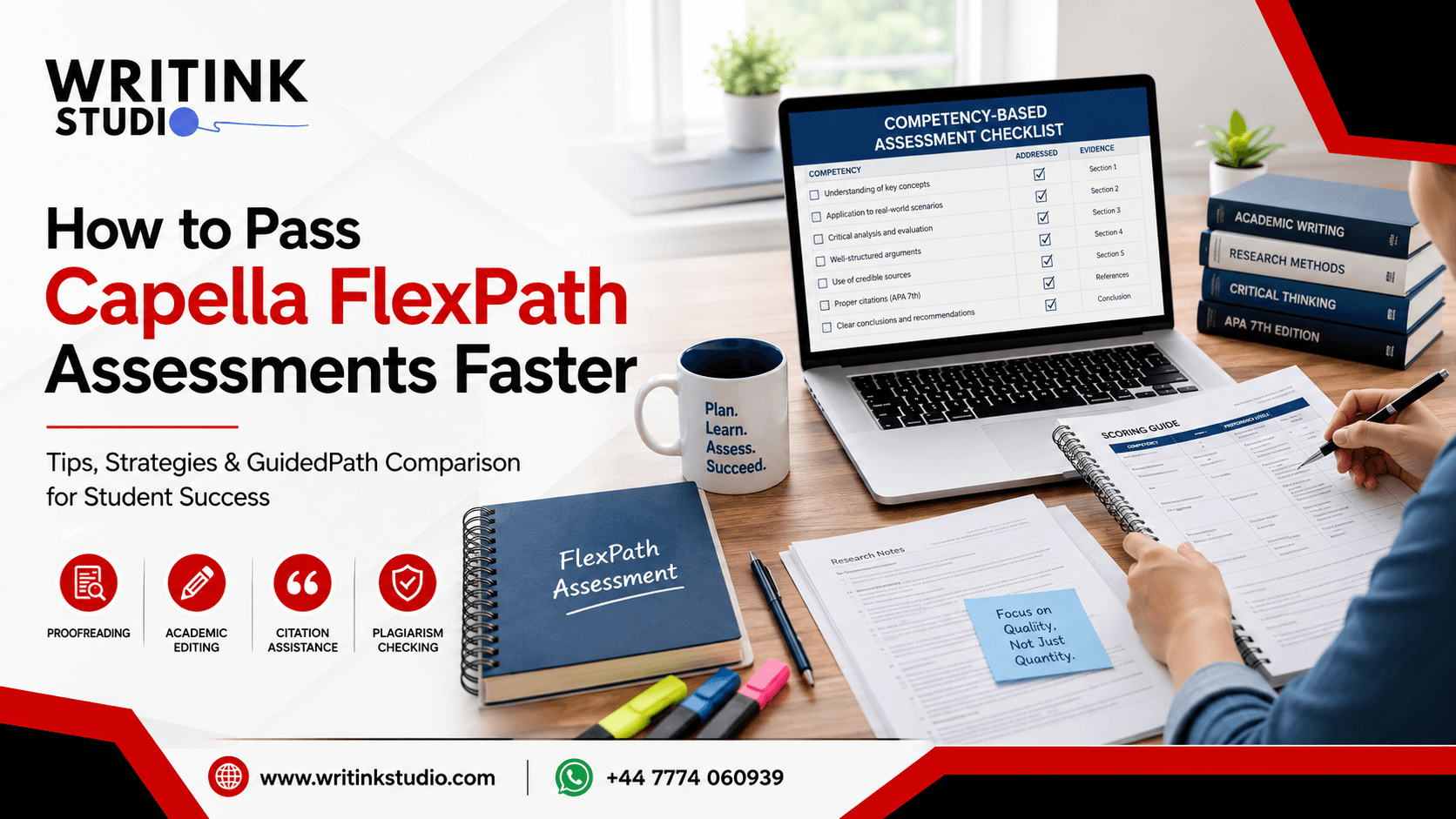
How to Pass Capella FlexPath Assessments Faster: A Complete Student Guide (2026)
If you’re studying through Capella FlexPath, you’ve probably asked yourself, “How can I complete assessments faster without compromising quality?” You’re certainly not the only one.
FlexPath is designed to give students more control over their learning, but that freedom also comes with responsibility. Without weekly deadlines or scheduled classes, it’s easy to lose momentum or spend far too much time on a single assessment.
The good news is that succeeding in Capella FlexPath assessments isn’t about working around the clock. It’s about using a smarter approach. By understanding the scoring guide, planning your research, and reviewing your work carefully before submission, you can make steady progress while producing high-quality assignments.
In this guide, you’ll learn practical strategies to complete assessments more efficiently, understand the difference between Capella FlexPath vs GuidedPath, and avoid common mistakes that slow students down.
What Are Capella FlexPath Assessments?
Unlike traditional exams, Capella FlexPath assessments are competency-based assignments designed to demonstrate what you’ve learned. Instead of focusing on weekly quizzes or class participation, you’ll complete written assessments that show your ability to apply concepts in real-world situations.
Each assessment includes a detailed scoring guide that outlines the competencies your instructor expects you to demonstrate. Treat this guide as your roadmap—it tells you exactly what success looks like.
One of the biggest mistakes students make is writing first and checking the scoring guide later. Reversing that process can save hours of unnecessary revisions.
Capella FlexPath vs GuidedPath: Which Is Better?
A common question among prospective students is “Capella FlexPath vs GuidedPath—which one should I choose?”
The answer depends on your learning style.
Capella FlexPath is self-paced. You decide when to study, when to submit assessments, and how quickly you progress through your courses. This flexibility makes it popular with working professionals, parents, and students who prefer learning independently.
Capella GuidedPath, on the other hand, follows a more structured schedule. Courses include weekly deadlines, instructor-led discussions, and regular class activities. If you prefer routine and accountability, GuidedPath may be a better fit.
Neither option is inherently better. FlexPath rewards self-discipline, while GuidedPath provides more structure. Understanding these differences can help you choose the learning format that matches your goals and schedule.
Start Every Assessment with the Scoring Guide
Before writing your introduction or searching for sources, spend time reading the scoring guide.
Highlight action words such as analyze, evaluate, recommend, or justify. These words explain exactly what your instructor expects.
Create a simple checklist based on each competency. As you complete your paper, tick off every requirement. This approach helps ensure that your assessment answers the right questions and reduces the need for revisions later.
Break Large Assignments into Smaller Tasks
A long assessment can feel overwhelming, especially if you’re balancing work and family commitments.
Instead of trying to complete everything in one sitting, divide the process into smaller steps:
- Review the assessment instructions.
- Read the scoring guide.
- Gather academic sources.
- Create an outline.
- Write one section at a time.
- Check citations.
- Proofread before submitting.
Completing small tasks consistently is often more effective than waiting for a full day of uninterrupted study.
Use High-Quality Academic Sources
Strong research strengthens every assignment.
Whenever possible, use peer-reviewed journals, academic books, government publications, and reputable research organizations rather than random websites.
Developing better research habits doesn’t just improve one assessment—it improves every piece of academic writing you produce. If you’re unsure how to organize multiple sources effectively, our guide on How to Write a Literature Review can help you build stronger research and critical analysis skills.
Focus on Competencies, Not Word Count
Many students worry about writing enough words.
In reality, instructors are usually assessing whether you’ve demonstrated the required competencies—not whether you’ve written the longest paper in the class.
Every paragraph should contribute to answering the assessment requirements. If a section doesn’t support your argument or address a competency, consider revising or removing it.
Quality always outweighs quantity.
Use AI as a Learning Tool, Not a Shortcut
Artificial intelligence has become part of modern education, and many students use it responsibly to improve their learning.
AI can help you:
- Brainstorm ideas.
- Understand difficult concepts.
- Improve sentence clarity.
- Create study plans.
- Review grammar.
However, your final assessment should always reflect your own understanding and research.
If you’re unsure how to use AI responsibly, our article How to Use ChatGPT for Assignments Without Breaking University Rules explains ethical ways to benefit from AI while respecting academic integrity.
Review Your Work Before Submission
After spending hours writing, it’s surprisingly difficult to notice your own mistakes.
That’s why proofreading is one of the most valuable steps in the writing process.
Before submitting your assessment, check:
- Grammar and spelling.
- Sentence clarity.
- Formatting consistency.
- APA citations and references.
- Alignment with the scoring guide.
Many students also find it helpful to review our article on 15 Common Assignment Mistakes That Cost Students Marks, which highlights simple issues that can affect grades.
Need Help Before You Submit?
Even experienced students benefit from a second review before submitting an important assessment.
If you’ve finished writing but want greater confidence in your work, our Proofreading Services can help identify grammar mistakes, awkward wording, formatting inconsistencies, and citation issues.
We also offer Coursework, Online Class, Online Course, Academic Editing, Citation Assistance, and Plagiarism Checking to help students polish their own work while respecting university academic integrity policies.
Whether you’re completing a FlexPath assessment, a research paper, or a literature review, careful editing can make your ideas clearer and your arguments stronger.
Need a final review before submitting your Capella assessment? Writink Studio helps students polish their own academic work with professional proofreading, academic editing, citation assistance, and plagiarism checks. If you’ve finished your assessment but want to make sure your writing is clear, your references are consistent, and your work is ready for submission, explore our academic support services before you hit Submit.
Final Thoughts
Success in Capella FlexPath assessments isn’t about rushing through courses—it’s about developing effective study habits.
Start with the scoring guide, research carefully, write with purpose, and always leave time to review your work before submission. Small improvements in planning, organization, and editing can save hours of revision and help you demonstrate your competencies more effectively.
Whether you’re comparing Capella FlexPath vs GuidedPath or you’re already progressing through your program, remember that consistency is more valuable than speed. Focus on learning, refining your writing, and submitting work that genuinely reflects your knowledge. Over time, those habits will not only help you complete assessments faster but also build the confidence and skills you’ll carry throughout your academic journey.